
Energy & Policy · Case study
European Energy Security Forum
Accelerating renewable energy development for reduction of energy dependence of Europe
Brussels · 26 September 2014
- My role
- Initiator and host, through Ibcentre; co-chair, opening speaker and moderator of the eastern-border session
- Organizer
- Ibcentre, in cooperation with Energy Watch Group
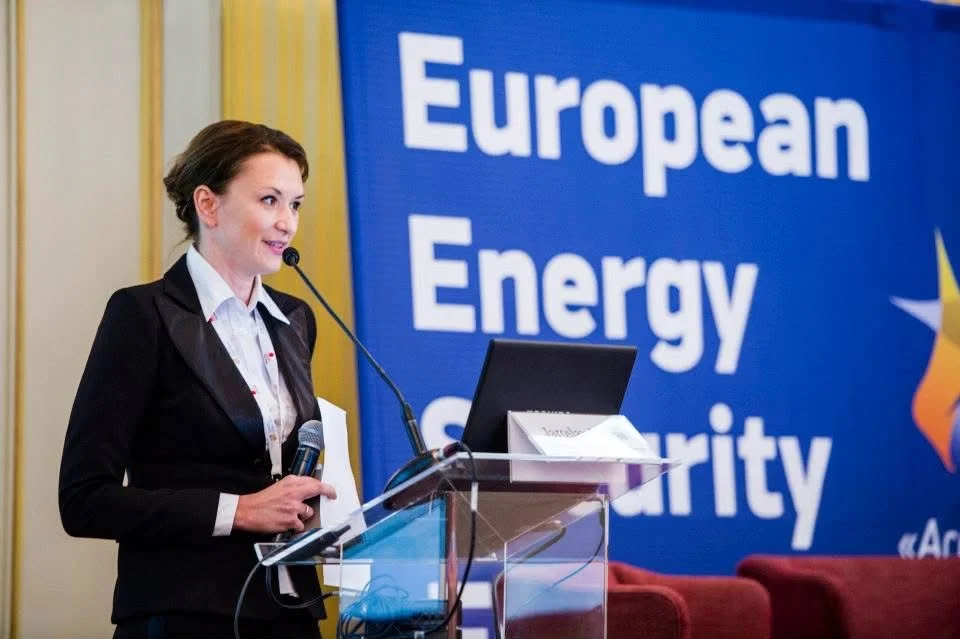
In 2014, I initiated the European Energy Security Forum (EuroSEF-2014) in Brussels to advance a specific proposition: renewable energy, supported by European manufacturing of renewable-energy technologies, should be central to Europe’s energy-security strategy.
The forum focused on reducing energy dependence across Europe, with particular attention to countries along the European Union’s eastern border and the wider region. I hoped it would help persuade European policymakers to take Russia’s aggression against Ukraine seriously, strengthen support for Ukraine, and accelerate renewable energy as a way to reduce Europe’s dependence on Russian oil and gas.
Why I initiated it
By late 2013, Europe’s dependence on Russian oil and gas felt to me like an existential security threat. The apparent cheapness of that energy concealed a much larger cost.
I was in the final months of pregnancy when I first shared the idea for a European Energy Security Forum with Hans-Josef Fell, co-author of Germany’s Renewable Energy Sources Act, in December 2013. Back in Kyiv, Maidan was unfolding. I was Executive Director of Ibcentre, and our Kyiv office was blocked from all sides. We had to evacuate colleagues and temporarily relocate part of the team to Moldova to keep our projects and operations moving.
After giving birth in February 2014, I returned to the idea. By spring, we were actively preparing and inviting senior government officials across Europe and European Commissioners. Energy Watch Group, led by Hans-Josef Fell, joined as co-organizer, with one purpose: to put renewables firmly on the energy-security agenda. The forum took place at the Steigenberger Grandhotel in Brussels on 26 September.
At the time, I described the forum’s aim this way:
“The aim of the EuroSEF is to share the latest updates about energy security questions and the measures taken today, as well as to discuss the possibilities and ways of greater inclusion of renewable energy in energy mix which can secure every region of Europe with domestic fuel heat and electricity produced from renewable sources.”
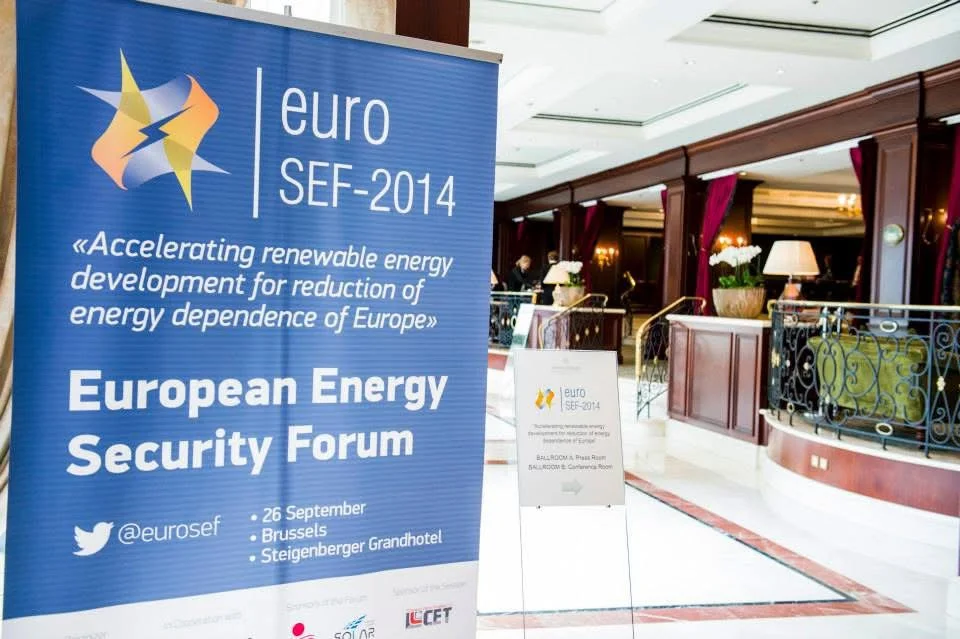
The forum
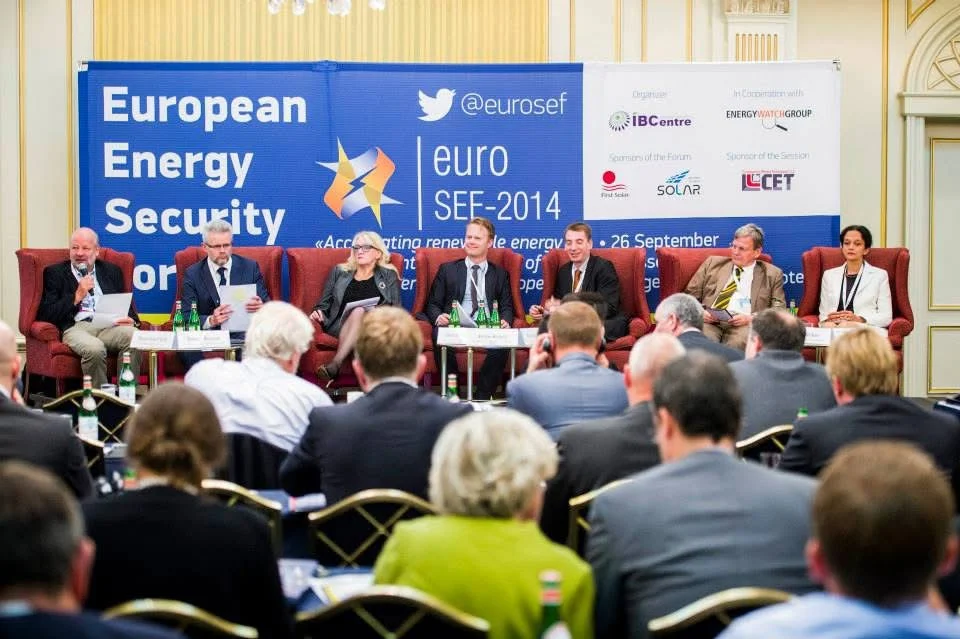
Ibcentre conceived, funded and organized the forum and developed its agenda. Energy Watch Group joined as partner, with Hans-Josef Fell serving as Conference Chairman.
EuroSEF-2014 brought together more than 100 representatives of public authorities, international experts, companies, research centres and press across six sessions. It was held under the auspices of eleven European and international renewable-energy associations, including the European Photovoltaic Industry Association, the World Wind Energy Association and the European Renewable Energies Federation.
Hans-Josef Fell chaired the conference and opened it together with Jaroslaw Pietras, Director General for Environment, Education, Transport and Energy at the Council of the European Union. Speakers included members of the European Parliament Benedek Jávor and Jeppe Kofod, former MEP Britta Thomsen, Eicke Weber of Fraunhofer ISE, Urban Rusnák of the Energy Charter Secretariat and Dolf Gielen of IRENA, alongside industry leaders from ABB, RWE, E.ON and First Solar.
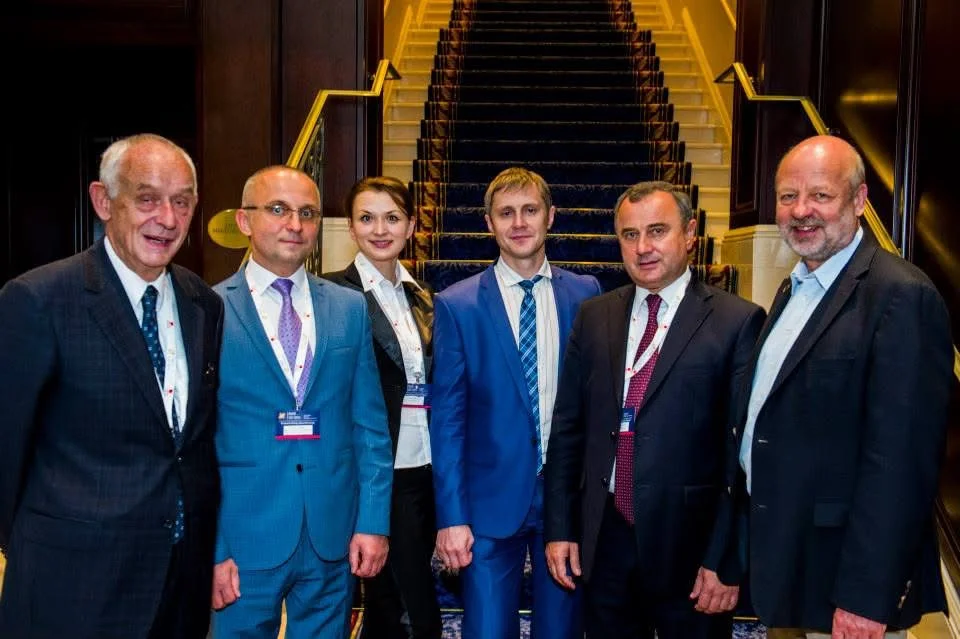
As host, I opened the forum with a speech on behalf of Ibcentre. I co-chaired the forum and moderated the session on building energy security along Europe’s eastern border, with senior officials from four countries:
- Estonia: Ando Leppiman, Deputy Secretary General for Energy, Ministry of Economic Affairs and Communications
- Turkey: Yusuf Yazar, General Director of Renewable Energy, Ministry of Energy and Natural Resources
- Azerbaijan: Jamil Malikov, Deputy Head, State Agency on Alternative and Renewable Energy Projects
- Georgia: Liza Tavdumadze, Head of Investment Department, Ministry of Energy
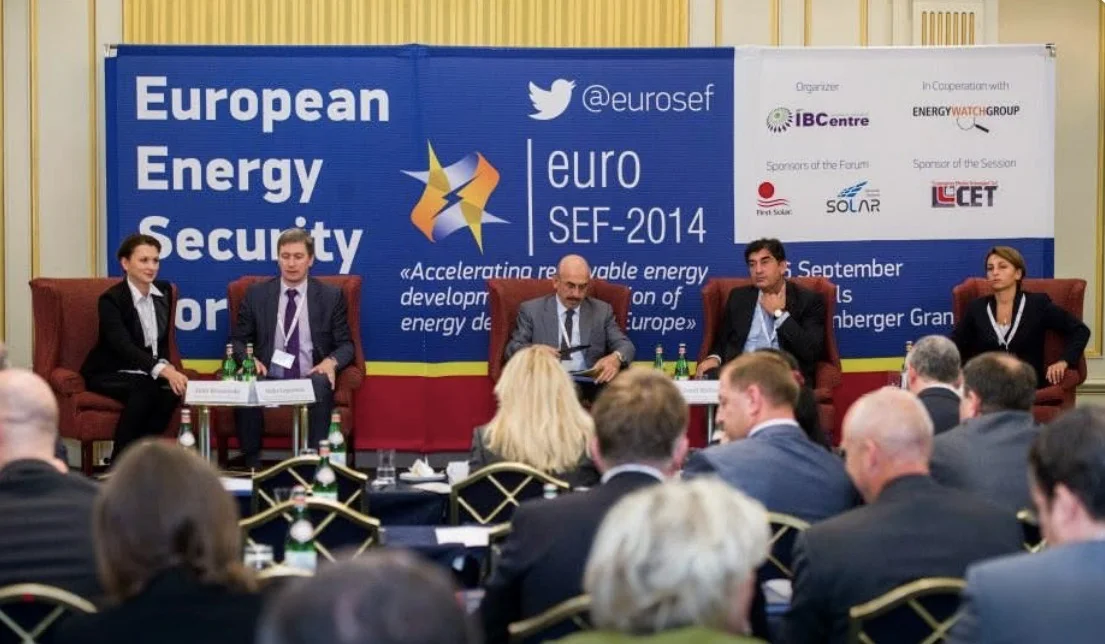
A dedicated panel on Ukraine brought together the head of Ukraine’s State Agency for Energy Efficiency, the deputy chairman of Naftogaz, parliamentarians and the country’s renewable-energy association.
The proposals and outcomes
The forum developed proposals addressed to the European Commission calling for an accelerated transition to renewable energy and a stronger European manufacturing base for renewable-energy technologies.
The proposals connected two priorities:
- Accelerating renewable-energy deployment to reduce dependence on imported fossil fuels and strengthen energy security.
- Strengthening European manufacturing of renewable-energy technologies as part of building the capacity to sustain that transition.
Representatives of state institutions from countries along the EU’s eastern border and the wider region expressed their willingness to strengthen energy independence. On the Ukraine panel, Ukrainian MP Oleksandr Dombrovskiy announced a proposal for a European Energy Platform for Ukraine, to transfer European expertise from municipalities, businesses, policymakers and NGOs, and invited Hans-Josef Fell to serve as founding co-chair.
Looking back
Reality turned out much worse. For the next eight years, Europe continued buying Russian oil and gas while Russia waged war against Ukraine. To me, the cynicism was especially stark: Russian gas still reached European buyers through Ukrainian pipelines, while European traders also used Ukraine’s underground gas storage facilities.
It took the full-scale invasion in 2022 for EU leaders to commit collectively to phasing out Russian fossil fuels. They agreed on it at Versailles in March, and in May the European Commission presented the REPowerEU plan, combining energy savings, diversification of supplies and an accelerated clean-energy transition.
That was the urgency I had hoped to convey in Brussels eight years earlier.
Connection to my work today
This initiative forms part of my longer work across renewable-energy markets, policy and innovation. It also informs my work through the Sustainable Innovation Council: examining which technologies address consequential problems, what prevents their deployment, and how institutions and capital can help them reach the people and places that need them.
Historical context
Press and records from 2014
- Ibcentre announcement of EuroSEF-2014, July 2014 (Energy XPRT)
- Pre-event press release (pv magazine)
- Event listing, Association of European Renewable Energy Research Centres (EUREC)
- Event listing, European-Ukrainian Energy Agency (EUEA), media partner
- Event listing, Danube-INCO.NET
- Post-event release (Word file)